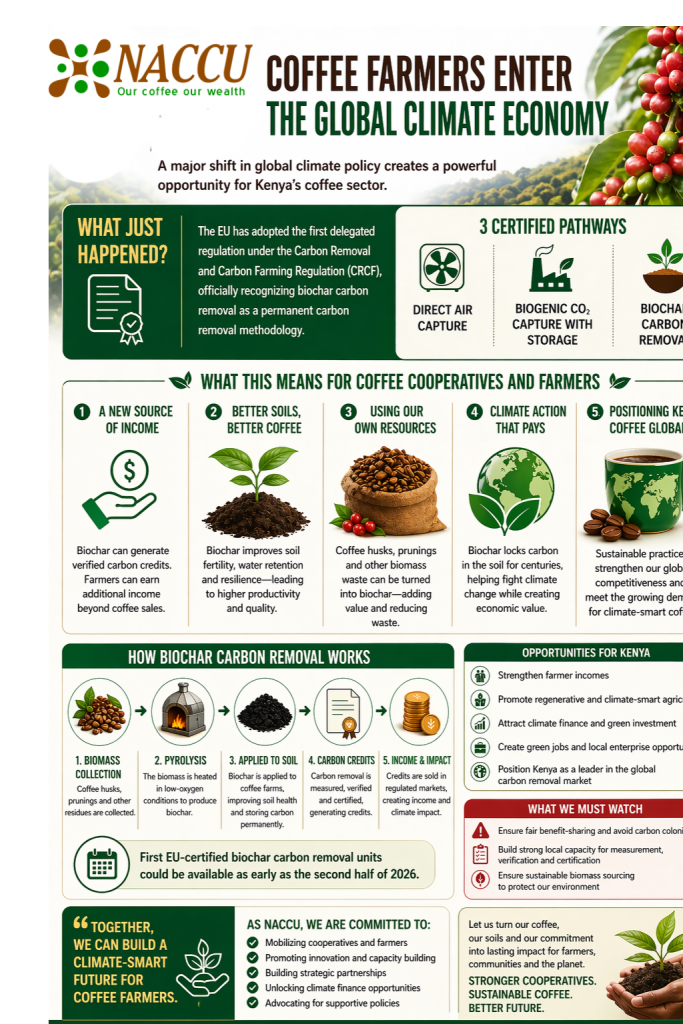

A New Opportunity for Kenya’s Coffee Cooperatives
The global conversation around climate change is rapidly evolving. Beyond reducing emissions, countries and institutions are now focusing on carbon removal — permanently removing carbon dioxide from the atmosphere. Recent international policy developments recognizing biochar carbon removal mark a significant milestone, opening new opportunities for agricultural sectors worldwide.
For Kenya’s coffee industry, this shift represents more than environmental progress. It introduces a transformative pathway where coffee farmers can actively participate in the global climate economy while strengthening productivity and resilience at the farm level.
From Coffee Production to Climate Solutions
Coffee farming has long been a cornerstone of rural livelihoods in Kenya. Cooperative societies supported by the National Coffee Cooperative Union bring together thousands of smallholder farmers who depend on coffee for income, community development, and economic stability.
Today, agriculture is gaining recognition not only as a food production system but also as a powerful climate solution. Coffee farms naturally generate biomass — including coffee husks, pulp, prunings, and other organic residues. Traditionally treated as waste, this biomass can now be transformed into biochar, a stable carbon-rich material produced through controlled heating of organic matter.
Biochar improves soil structure, increases water retention, enhances nutrient availability, and stores carbon in the soil for decades or even centuries. This means coffee farmers can simultaneously increase yields and contribute to climate mitigation.
What Biochar Means for Coffee Farmers
The recognition of biochar as a permanent carbon removal pathway creates a new opportunity for cooperative-led innovation. Instead of relying solely on coffee sales, farmers may benefit from multiple value streams linked to sustainable land management.
Biochar adoption offers several important advantages for coffee farmers and agricultural communities. One of the most significant benefits is improved soil fertility and long-term productivity. When applied to farmland, biochar enhances soil structure, increases nutrient retention, and supports beneficial microbial activity. This creates healthier soils capable of sustaining crop production over many seasons, helping farmers achieve consistent yields while maintaining land quality.
Another key advantage is increased resilience against drought and changing weather patterns. Biochar improves the soil’s ability to retain water, allowing crops to withstand dry periods more effectively. In regions increasingly affected by climate variability, this added moisture retention helps stabilize production and reduces the risks associated with unpredictable rainfall and extreme weather conditions.
Biochar also contributes to reducing dependence on expensive chemical fertilizers. By improving nutrient availability and minimizing nutrient loss through leaching, farmers can lower input costs while maintaining strong crop performance. This not only supports farm profitability but also promotes environmentally sustainable agricultural practices.
In addition, biochar adoption creates the potential for participation in certified carbon markets. Because biochar stores carbon in a stable form within the soil for long periods, farmers and cooperatives may benefit from emerging carbon credit systems that reward verified carbon removal. This opens new income opportunities, allowing farmers to earn from climate-smart land management alongside traditional agricultural production.
The Role of Cooperatives in the Climate Economy
Carbon markets require coordination, verification, and accountability — elements that individual farmers cannot easily manage alone. Cooperative societies therefore play a critical role in enabling participation.
NACCU views cooperatives as the bridge connecting local farmers to emerging global climate finance systems. By organizing farmers at scale, cooperatives ensure that climate opportunities remain inclusive, transparent, and farmer-centered.
Strengthening Sustainability in Kenya’s Coffee Sector
Kenyan coffee is globally respected for its quality and unique flavor profile. However, the future competitiveness of the sector increasingly depends on sustainability and climate resilience.
Climate-smart innovations such as biochar align perfectly with the long-term vision of sustainable coffee production. Healthy soils lead to healthier coffee trees, improved yields, and consistent quality — all essential factors in maintaining Kenya’s reputation in international markets.
At the same time, integrating climate solutions into coffee farming positions Kenyan cooperatives as leaders in responsible agriculture, responding to growing global demand for environmentally sustainable products.
Opportunities and Responsibilities Ahead
While the potential is significant, successful adoption requires careful planning and collaboration. Training, research partnerships, policy alignment, and farmer awareness will be essential to ensure that carbon initiatives truly benefit producers.
The National Coffee Cooperative Union remains firmly committed to promoting farmer education on climate-smart agriculture as a foundation for the future of Kenya’s coffee sector. By strengthening knowledge on sustainable farming practices, soil health management, and climate resilience, NACCU seeks to equip farmers with practical skills that improve productivity while protecting natural resources.
At the same time, NACCU continues to support innovation within cooperative societies. Embracing new technologies, sustainable processing methods, and climate-focused solutions enables cooperatives to remain competitive in a rapidly changing global agricultural environment. Innovation is viewed not as a replacement for tradition, but as a tool that empowers farmers to adapt, grow, and unlock new economic opportunities.
NACCU also advocates for fair and inclusive participation of coffee farmers in emerging carbon markets. As global climate initiatives expand, it is essential that smallholder farmers receive equitable benefits from carbon financing and environmental programs. Through cooperative structures, NACCU works to ensure transparency, accountability, and farmer-centered participation in these new climate economies.
The goal is not merely to follow global trends, but to actively shape them in ways that empower Kenyan farmers, strengthen cooperative institutions, and promote sustainable development across rural communities.
A Climate-Smart Future for Coffee
The future of coffee extends beyond productivity and market prices. It now includes environmental stewardship, innovation, and participation in the global climate transition.
Coffee farmers are uniquely positioned to become custodians of both agricultural excellence and climate solutions. By embracing practices such as biochar production, Kenya’s cooperative movement can unlock new economic opportunities while safeguarding the environment for future generations.
Through collaboration, innovation, and strong cooperative leadership, Kenyan coffee farmers are stepping into a new era — one where coffee contributes not only to livelihoods but also to the health of the planet.
The future of coffee is sustainable, climate-smart, and farmer-driven. ☕🌱