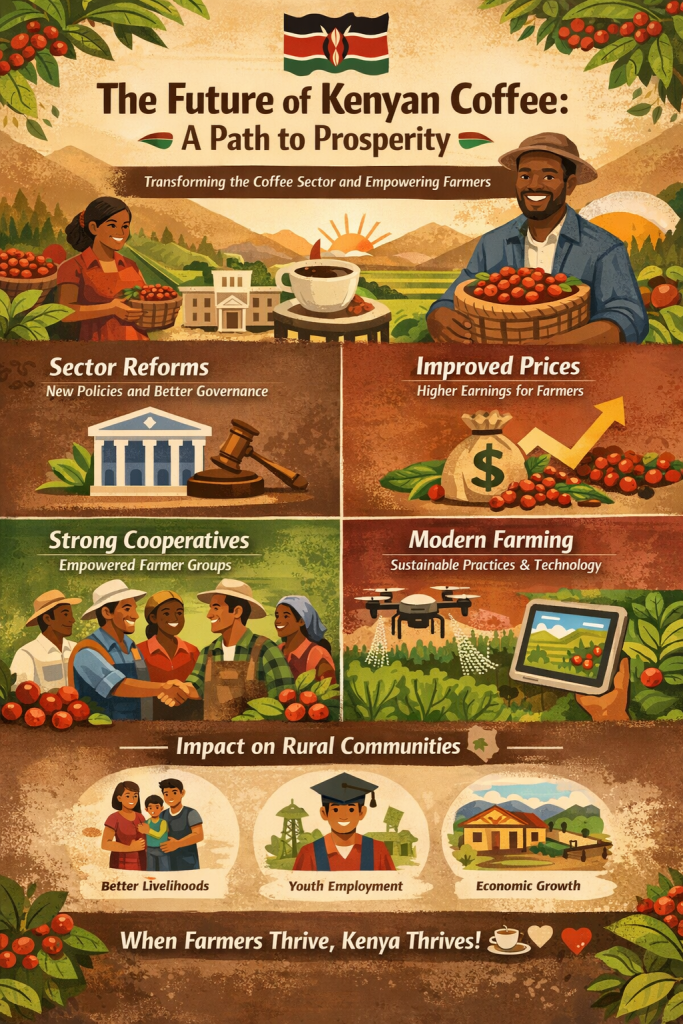
Kenya’s coffee sector is undergoing a significant transformation driven by policy reforms, market improvements, and renewed investment across the value chain. For many years, coffee farmers faced declining production, delayed payments, weak cooperative governance, and reduced profitability. Despite Kenya’s global reputation for producing premium quality coffee, many smallholder farmers struggled to earn sustainable incomes. Today, however, new developments are reshaping the industry and restoring hope among farmers.
The renewed national focus on coffee recognizes the crop not only as an export commodity but also as a vital source of rural employment and economic stability. Stakeholders across government, cooperatives, and private sector institutions are working together to address long-standing challenges and create a farmer-centered coffee economy. These changes aim to ensure that farmers receive fair value for their hard work while strengthening the sustainability of the entire sector.
Policy Reforms and Institutional Strengthening
One of the most important milestones in the coffee industry has been the restructuring of sector governance through strengthened oversight by the Coffee Board of Kenya. The reformed regulatory framework seeks to improve coordination, promote Kenyan coffee internationally, and enhance accountability among millers, marketers, and dealers. By streamlining licensing processes and enforcing clearer industry standards, the reforms are expected to eliminate inefficiencies that previously disadvantaged farmers.
Improved governance means farmers can now operate within a more predictable and transparent system. Clear regulations reduce conflicts of interest within the value chain and help ensure that payments and services reach farmers more efficiently. As institutions become stronger and more responsive, farmers gain confidence that the industry is working in their favor.
Improved Marketing and Transparent Coffee Trading
Marketing reforms have also strengthened operations at the Nairobi Coffee Exchange, Kenya’s central coffee auction platform. Enhanced transparency and modernization of trading systems are helping ensure that coffee prices accurately reflect global demand and quality grading. This reduces price manipulation and allows farmers to benefit more directly from premium market prices.
Faster payment systems are another major improvement. Farmers and cooperative societies are increasingly receiving payments within shorter timelines after coffee sales. Timely payments enable farmers to invest in fertilizers, farm maintenance, education, and household needs without financial strain. Reliable income flow significantly improves living standards and encourages continued participation in coffee farming.
Rising Prices and Renewed Farmer Motivation
Global demand for specialty coffee continues to favor Kenyan beans due to their unique flavor profile and high quality. Improved international prices have revitalized farmer motivation, encouraging the rehabilitation of neglected coffee farms and the planting of new seedlings. Many farmers who had shifted to alternative crops are reconsidering coffee farming as profitability improves.
Higher returns are also attracting younger generations back into agriculture. Youth involvement is essential for the long-term sustainability of the sector, and improved earnings are making coffee farming appear modern, viable, and economically rewarding. As confidence grows, productivity is expected to increase nationwide.
Stronger Cooperative Societies and Farmer Empowerment
Cooperative societies remain the backbone of Kenya’s coffee industry, and current reforms emphasize transparency, professional management, and democratic participation within cooperatives. Stronger cooperatives enhance farmers’ collective bargaining power, enabling them to negotiate better prices, access financing, and provide essential extension services.
Well-managed cooperatives also support value addition initiatives such as improved processing, branding, and market linkages. When cooperatives function efficiently, farmers benefit not only from higher earnings but also from training opportunities and shared resources that improve farm productivity and quality standards.
Technology, Sustainability, and Climate Resilience
Another important development is the integration of technology and climate-smart agricultural practices into coffee farming. Farmers are increasingly accessing digital advisory platforms, weather forecasting information, and improved agronomic training programs. These tools help farmers manage pests, diseases, and unpredictable weather patterns that have historically reduced yields.
Climate-resilient farming practices are particularly important as environmental conditions continue to change. Sustainable soil management, water conservation, and improved crop varieties are helping farmers maintain productivity while protecting natural resources. This ensures that coffee farming remains viable for future generations.
Growing Domestic Consumption and Value Addition
Kenya is also experiencing growth in local coffee consumption as urban coffee culture expands. Increased domestic demand creates alternative markets beyond exports, allowing farmers to benefit from local roasting, branding, and direct marketing opportunities. Retaining more value within the country strengthens the entire coffee ecosystem and increases farmer income potential.
Local consumption also promotes national pride in Kenyan coffee and encourages closer connections between consumers and producers. As more Kenyans embrace locally grown coffee, farmers gain stable demand and reduced exposure to fluctuations in international markets.
Conclusion: Transforming Coffee into a Tool for Prosperity
The ongoing transformation of Kenya’s coffee sector represents a renewed commitment to improving farmers’ livelihoods. Policy reforms, transparent marketing systems, stronger cooperatives, technological innovation, and expanding markets are collectively creating a more equitable and sustainable coffee industry.
For farmers, these developments translate into higher incomes, timely payments, better institutional support, and renewed dignity in coffee farming. If implementation continues successfully, coffee has the potential to once again become a powerful driver of rural development, employment creation, and economic prosperity across Kenya. The future of Kenyan coffee therefore lies not only in global recognition but in the improved quality of life for the farmers who produce one of the world’s finest coffees.