Kenya’s coffee sector is witnessing a quiet but significant shift. Recent performance trends from Nandi and Bungoma counties show that emerging regions are no longer playing a supporting role — they are becoming central contributors to the country’s coffee economy.
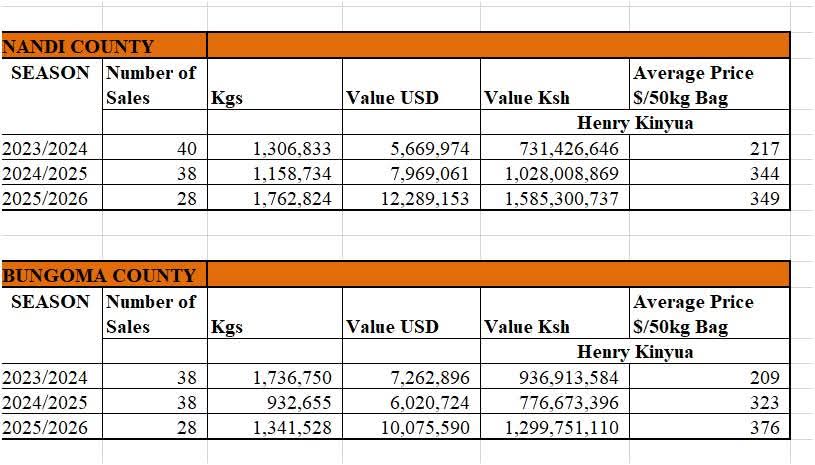
Data from the Nairobi Coffee Exchange over the past three seasons reveals consistent improvement in both value and pricing. Nandi County has demonstrated remarkable recovery driven by increased volumes alongside rising auction prices, while Bungoma County has distinguished itself through premium-quality coffee attracting some of the highest average prices recorded this season.
What makes this transformation particularly important is that it does not appear to be a one-season anomaly. Instead, it reflects deeper institutional and organizational improvements within cooperative societies.
A notable factor behind this progress is the growing influence of organized farmer unions such as the National Coffee Cooperative Union Kenya (NACCU). Many societies contributing to these strong results are NACCU members, benefiting from strengthened governance structures, farmer capacity building, quality improvement initiatives, and collective market representation.
These interventions are helping farmers move beyond volume-focused production toward quality-driven competitiveness — the key determinant of success in today’s specialty and premium coffee markets.
While the 2025/2026 season is still ongoing, early indicators suggest that earnings and volumes may continue to rise. If current trends hold, the Rift Valley region could increasingly become a major pillar of Kenya’s coffee industry.
The takeaway is clear: sustainable coffee growth is no longer defined by historical reputation alone. It is being shaped by well-managed cooperatives, empowered farmers, and strong institutional support — proving that when cooperatives thrive, the entire coffee value chain benefits.